
Far from every small business has money to burn on ads and marketing to gain market share. This is where marketing strategies for small business owners with no budget come into play. In this blog, we’ll share 9 of those that require effort, not money. All of them help your brand become easy to find, trust, and recommend. We’ll also explain what each one is good for and outline a simple 30-day plan to promote your business, whether you’re an upstart legal office in Pasadena, a roofer in Illinois, or a landscaper from the UK.
We recommend working through the list in order.
Online Marketing With No Budget | Short Rundown of the Basics
Without a consistent budget, you’ll have to accept the fact that you’re going to need to spend time. That’s a trade-off every SMB should be willing to make.
None of these can guarantee results, but quality efforts should combine over time and develop into valuable assets down the line. Ad spend is always an option, but they stop working the second your money runs out. None of the nine methods below are like that, retaining residual value for weeks, months, or even years after you did the work.
Let’s get to it.
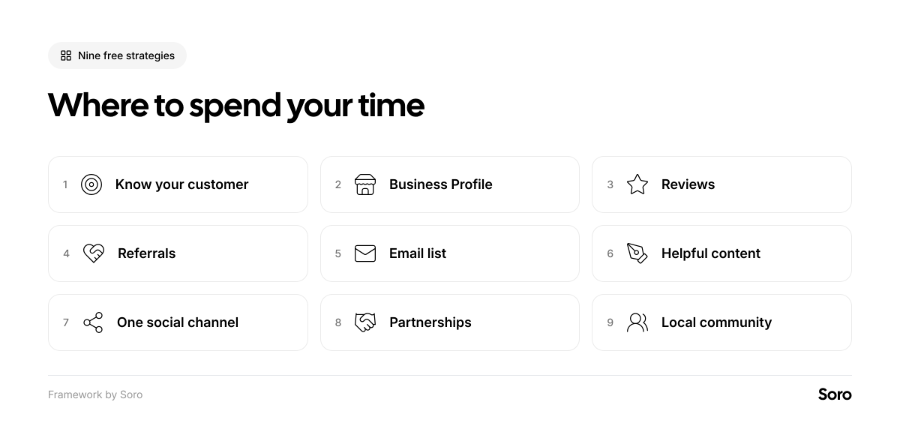
Know Exactly Who You’re for (Refine the Target Customer)
Before any strategic work, write one sentence: “We help [who] with [problem] in [where]."
For example: “We fix leaking roofs for homeowners in Dayton." While it sounds basic, it is the defining factor in determining where you show up on Google, what you need to write, and who you need to ask for referrals. All of the ideas below will work better when they’re aimed at a clearly outlined customer group.
2. Set Up Your Free Google Business Profile
Setting up the GBP (Google Business Profile) is free, and the highest-leverage free move you can make. That’s important for both outcall-driven businesses and organizations where customers can visit.
Numbers back our claim. In BrightLocal's 2026 research, 52% of consumers started their latest local business search on Google Search, and another 9% started on Google Maps. That’s over 60% of potential clients who may click on your competitors’ links. If you fill out and refine it, your GBP will show up on Maps and Search, with hours, photos, and reviews.
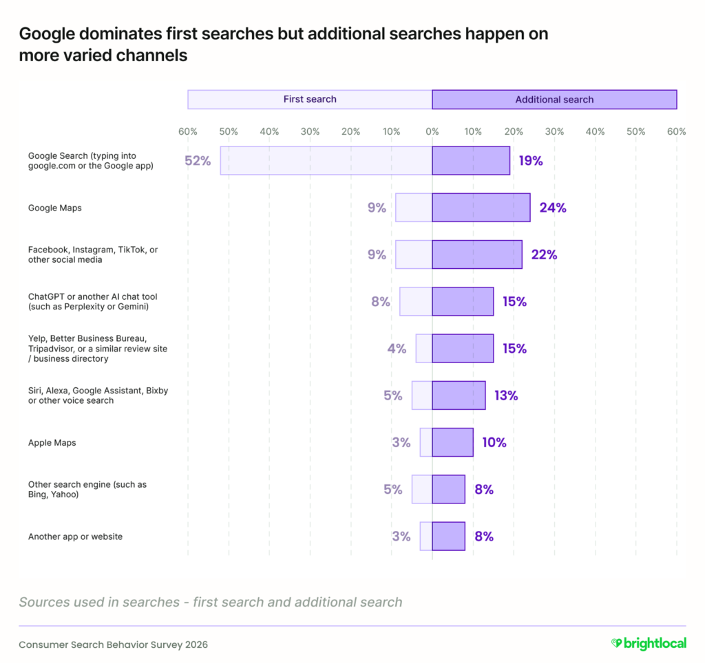
Image source: BrightLocal: Consumer Search Behavior 2026, Channels
Before you dive into the more specific niches on how to advertise your business, fill in every GBP section, choose the most specific category, and add real photos. Google claims that businesses with complete and accurate information will have a higher shot of showing up in local search results.
Our Google Business Profile optimization checklist walks through the process step-by-step. Still, a profile shouldn’t be looked at as a one-and-done type of job. Keeping the profile active is a huge value driver. Posting and replying to reviews within a couple of days takes some time, but it does boost trust. If that's the part you'd rather hand off, Soro Local is one option, as it manages the profile, publishes regular posts, and replies to reviews automatically.
3. Ask Every Customer for a Review
Reviews are free marketing. They also keep working, since there’s no substitute for word-of-mouth, even if it’s from a stranger on Google.
Another survey from BrightLocal concluded that 97% of consumers read reviews for local businesses. What’s more, a staggering 74% only care about the reviews from the past 3 months, so a steady flow is what you need since it matters way more than a one-time push.
We recommend setting up an ask template so you request reviews the same way right after an experience. Send a direct link via a message, email, or provide a QR code they can scan. Never offer anything in exchange, as Google bans incentivized reviews.
Our guide to creating a Google review link shows how to set it up in minutes.
4. Make Referrals Easy
True word of mouth, especially for service providers, is still the most trusted way of how to promote your business. A study of U.S. consumers from Nielsen in 2021 showed that 89% of people trusted recommendations from people they know more than any other source. When you’re an SMB or just getting started, don’t leave it to chance and:
- Tell happy customers you’re growing and that referrals help.
- Give them something easy to forward, like a short text or a link.
- Thank every person who sends someone your way, even if the job doesn’t happen.
Yes, that will take time and effort, but if you execute at even 80-90% capacity for this, a customer will definitely remember it. They’ll keep recommending you to other people because you’ll seem caring, decent, and professional.
5. Start an Email List on Day One
Social media platforms and Google (as well as other search engines) can change rules and terms overnight. An email list is the only audience you can truly call your own.
Collect emails at checkout, on your website, and in forms in person. Give people a clear incentivized reason to sign up. These include:
- Early access
- Automatic seasonal reminders
- Discount codes
- Tips & tricks
- Useful checklists
Ideally, try to create and send something genuinely useful once or twice per month. In the same Nielsen study we cited above, recommendations from people you know and emails people signed up for were almost twice as likely to lead to an action.
6. Publish Helpful Content (the Slow, Free Engine)
Refine topics and publish content on your blog or dedicated landing pages that would answer the questions your customers already ask. These include but aren’t limited to:
- Price for X
- Timelines for X
- “Is this normal?”
- Comparisons between products and services
- Common mistake overviews with solutions
Each good page can bring in visitors from Google for months or years after publishing without making you pay for a single click. To every SMB, that’s one of the most durable small business marketing ideas, and it's the core of building an SEO content strategy.
Still, you need to be honest with yourself about timing. Back in 2017, Google said it can take 4-12 months for improvements to show on this front. Even though years have passed, the trend remains, and our guide to how long SEO takes breaks that down.
Start with this today, and view content as a strategy that should pay off later while the others bring in customers this week. It’s definitely possible to write everything yourself or to assign it to a team member. However, if writing insightful pieces on a weekly basis isn’t realistic, Soro can take that off your plate. It will auto-research, write, and publish fully SEO-optimized content for your site. All the while, you can focus on your customers.
7. Pick One Social Channel and Show Up
It’s a myth that you need to be everywhere, especially if you’re a small business. Pick the platform your customers are most likely to be at and post there consistently. Pew Research Center's 2026 survey shows where U.S. adults are most likely to be found:
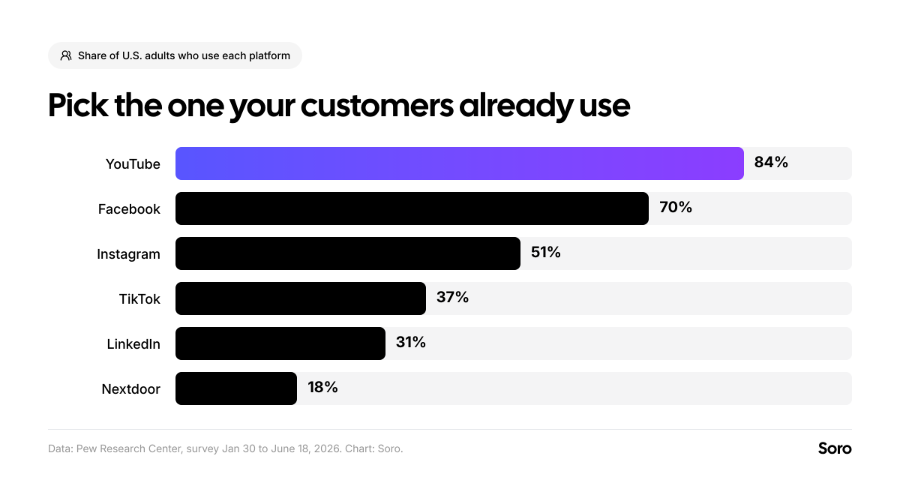
Image source: Soro (original chart; data from Pew Research Center, 2026)
If you’re a home service business, Facebook, Nextdoor, and Instagram should be solid picks. If you’re a legal consultant or a service provider in the B2B segment, it’s definitely LinkedIn, while cafes and salons shouldn’t prioritize anything over Instagram. Whichever channel you choose, share real work. Post real before-and-after photos, tips, case studies, or interesting situations; answer common questions, and share offers.
One good post per week beats five rushed, random ones.
8. Partner With Businesses That Share Your Customers
When wondering how to promote your business, don’t just think inside the box. Find businesses that serve the same people without competing.
Some examples:
- Wedding photographer + coordinator or florist
- Plumber + a kitchen fitter
- An accountant + bookkeeper
- Car repair shop + insurance broker
- Landscaper + lawn mower shop
Contact them to propose swapping referrals. You can also share each other’s posts on social media, co-host workshops or seminars, bundle offers, etc. Yes, there’s a lot of administrative work involved, and it takes time, but it costs almost nothing. To round things out, doing the work here puts you in front of customers who already trust your partner.
9. Show Up in Your Local Community
Some of the cheapest marketing happens offline. Send someone or personally show up to volunteer in local events, give free talks at the library, answer questions in local online groups without pitching, or pitch a story to the local paper.
A strong voice in the community goes a long way for service businesses. These also tend to earn mentions and links from local websites, which help your search visibility; our guide to link building without a budget explains how.
How to Promote Your Business: A 30-Day Starter Plan
Trying all nine at once is nearly impossible or a direct path to giving up. Here’s a simple first month starter plan that should cover the essentials for most:
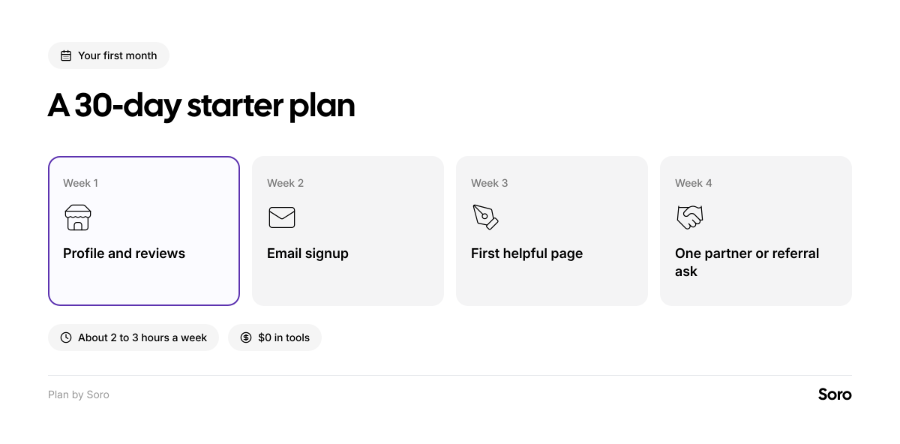
- Week 1. Write the one-sentence pitch. Then, set up the Google Business Profile and ask your last 10 (or all, if you have fewer) for reviews. (< 1 hour)
- Week 2. Set up an email newsletter, and integrate an email signup option on the website and checkout (if applicable). Also compose and send your first short email. (<2.5 hours)
- Week 3. Write and publish a helpful blog or a landing page to answer the most common question from customers. (<2.5 hours)
- Week 4. Ask one business that may be a suitable partner to swap referrals and ask happy customers to recommend you. (<1 hour)
What’s next? Keep going, or add social media to your to-do list if you have more time. Whenever a new customer comes around, track where they came from and do more of what works. For a fuller beginner's walkthrough, you can also see how to market a small business with zero experience.
What to Skip When Money Is Tight
While we understand that knowing these small business marketing ideas may boost your confidence, you should always have paid ads at the back of your mind. They work well for bringing in leads quickly, but if money’s tight, be very careful about how you approach spending. Here is a quick overview of 4 key mistakes we strongly suggest avoiding:
- Buying followers or reviews. That breaks platform rules and doesn’t build a tangible foundation.
- Trying to be on every platform. Diluting effort everywhere beats doing nothing. Focus wins on social media.
- Paying for tools before you genuinely need them. Free versions can cover most needs early on.
- Copying big brands. You need customers this month while most of these market for awareness-first.
Once there’s a stable stream of extra, disposable income, you can divert some of it to paid ads, influencer promos, UGC ads, and other. For now, focus on free channels that build over time.
Short Summary
Hopefully it’s now clear that even small businesses without an ad budget can still market effectively when they opt to trade money for time. The nine free marketing strategies for a small business are optional, but defining your target customer, setting up a Google Business Profile, asking for reviews, making referrals easy, starting an email list, publishing helpful content, and picking one social media channel seem like the best jumping-off points.
The 30-day starter plan could provide a good sense of how to distribute your time. Meanwhile, try to avoid common mistakes to maintain consistent growth.
FAQ
What is the Best Marketing Strategy for a Small Business With No Money?
For a local business, a complete Google Business Profile plus a steady flow of reviews is usually the fastest free win. For an online establishment, starting with an email list and publishing helpful content are the main go-tos.
How Much Time Does No-Budget Marketing Take?
This type of small business marketing should require a few hours per week. If you can automate some tasks, that’s even better. Overall, consistency matters more than sheer volume, as a little every week beats the mightiest of one-time pushes.
How Long Until Free Marketing Brings in Customers?
That depends on which specific method we’re talking about. Referrals, reviews, and your GBP can help within a couple of weeks. Content and SEO work take longer, with Google preparing you to wait 4-12 months to see benefits.