
Most businesses and even SEO agencies outsource content writing. They usually don’t plan for it at first. It just happens. From an agency’s POV, a new client signs, the in-house writer is already booked, and you choose a freelancer to handle the assignment. The first few articles are fine. By month 3, the client’s voice drifts, refinements are needed, and someone on your team needs to quietly rewrite almost everything before it ships. Our guide covers how to avoid that, what outsourced content writing services cost, how to build a system before you hire, and what quality checks to implement.
Why Agencies Outsource Content Writing (and Where It Breaks)
Content Marketing Institute did a survey with B2B marketers. In it, half of all B2B marketers revealed they outsource at least some content marketing tasks. What’s even more interesting, the number rose to 75% at companies with employee counts of 1,000+.
In CMI’s 2026 report, “resource constraints — time, people, budget" was the 2nd-biggest content challenge, identified by 39% of marketers, just behind 40% for creating actionable content. So, having time to write seems to be as big a challenge as writing well.
Outsourcing itself isn't what creates the bottleneck. What breaks is the handoff. A writer who’s outside your agency won’t know the client’s product/service, banned phrases, or what did well with the last 10 posts. Without those details written down, gaps get filled with guesswork, and your editors pay for it in their own hours.
What Content Writing Services Cost in 2026
Let’s talk money. Prices for content writing services vary more than almost any other input from an SEO agency. Here’s what we found when researching how to hire a content writer and how much it costs. We present the information in a table for convenience.
| Option | Typical price | Source |
|---|---|---|
| Freelancer on Upwork | $25/hour median (typical range of $15–$40) | Upwork data |
| Freelance blog writer (EFA members, top-tier) | 25–45¢ per word | EFA 2026 Rate Chart, 1,100+ respondents |
| Dedicated content delivery platform (100% human) | ~16-20¢ per word | Average pricing, public online data |
| Dedicated content delivery platform (AI + human) | ~6-10¢ per word (plus added in-platform fees) | Average pricing, public online data |
| Writer marketplace | 4¢ to $1+ per word, depending on writer level | Public online data |
| Average blog post, human-written vs. AI-generated | $611 vs. $131 | Ahrefs survey of 879 marketers |

Sources: Upwork, EFA 2026 Rate Chart, Ahrefs
You can crunch the numbers on a standard 1,500-word post.
- $90-$150 at 6-10¢ per word: AI + human before any platform fees
- $240-$300 at 16-20¢ per word: 100% human
- $60-$1,500 at 4¢-$1+ per word: writer marketplace, huge disparity, various levels
- Up to $675: from top-tier EFA members
The price gap is big, but it doesn’t even tell what matters most to an agency: how many editing hours a delivered blog will cost you before it’s client-ready. A cheap freelancer whose work requires hours of rewriting can end up costing more than a pricier specialist who ships a piece that takes only 5-10 minutes of review.
Finding “chemistry” sometimes is just as important as analyzing a writer’s CV.
Before You Hire a Content Writer, Build the System
The client (you) has the largest quality levers on their side. Get to know them and prepare them before you hire a content writer at all. These documents do most of the work.
1. A Brief for Every Piece (Landing Page, Description, or Blog Post)
Not just a title and keywords. It takes a lot of time, working together, mutual trust, and industry insider knowledge until that’s sufficient. A proper brief should answer:
- Who is this for?
- What should they know?
- What should they do after reading?
- Which keywords and what search intent are targeted?
- Which sources are useful or required?
- Which internal/external links to include?
- What the client never wants said?
If a writer has to guess, expect a revision round. Briefs are needed for every single task or task batch, at least.
2. One-Page Style Guide
It should contain:
- Tone in 3-4 adjectives
- Two example pieces or paragraphs that the client likes
- A list of no-nos: banned words and claims
- Rules for mentioning the client’s product
Update the style guide whenever you notice the same fixes from the editors happening 2-3 times.
3. Review Checklist
Luckily, there’s no need to invent one. Google has published a list of self-assessment questions for exactly this purpose. Everything starts with: “Does the content provide original information, reporting, research, or analysis?” Turn a few questions from the list below into your review checklist. Most add it to the bottom of their briefs to help writers aim at the same targets your editors are checking against.
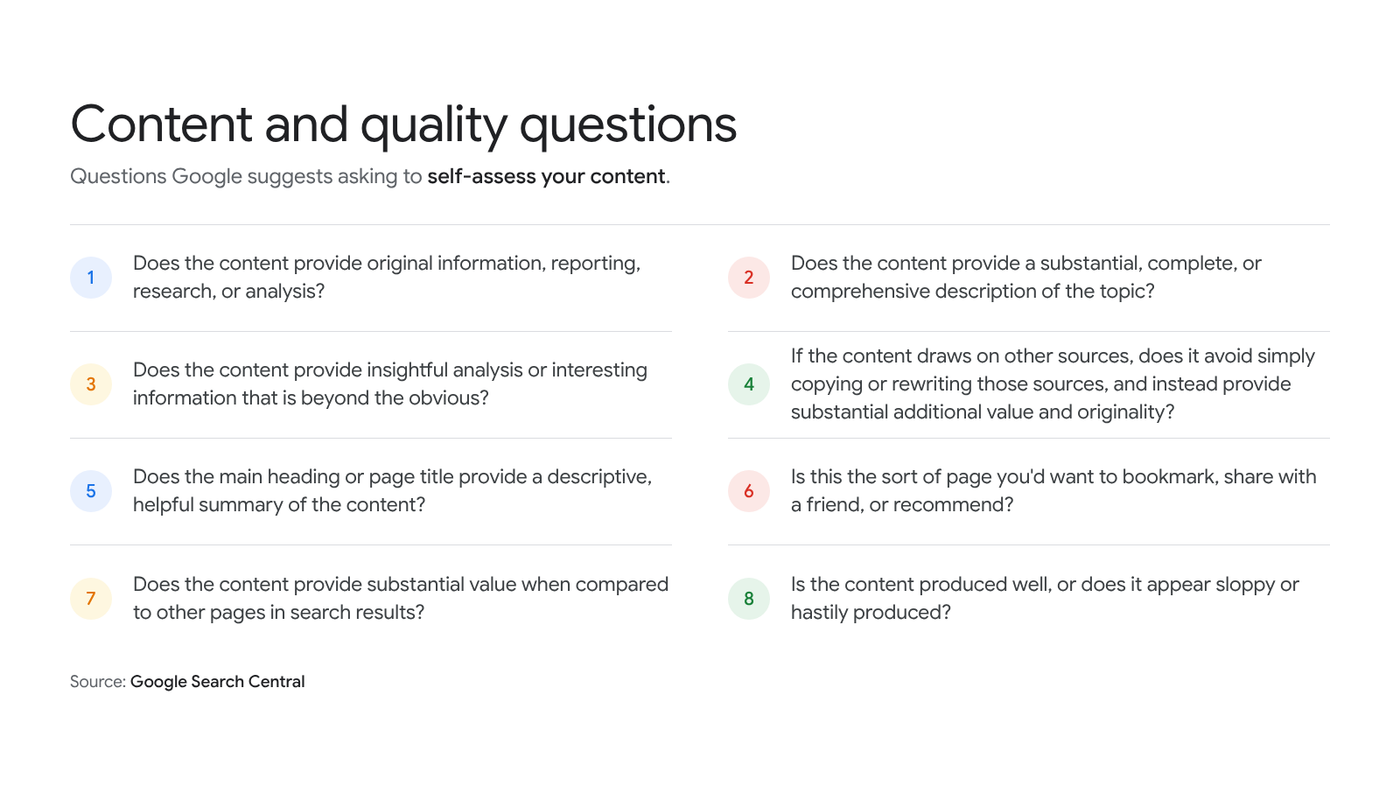
Source: Google Search Central — Creating helpful, reliable, people-first content
Maybe you’d like a primer on what properly SEO-optimized pages should look like in the first place? If that’s the case, Writing Content That Ranks is a piece worth reading before you outsource content writing.
The 5-Point Quality Check for Every Outsourced Article
We also recommend running every delivered piece through the same 5 checks before it reaches the client or is uploaded/published:
- It says something the top results don’t. Best-ranking content provides “Substantial additional value and originality”, rather than rewriting other sources, according to Google. The easiest way to do this is by giving an example from your portfolio, a clear expert opinion, or a real number.
- Facts that trace back to the original source. Best-ranking pieces have links to original sources for numbers or claims. The key word “original”, not just a blog that reused them.
- It matches search intent. Google the keyword and understand the search intent. If top-rankings are opinion pieces and you produce a step-by-step guide, it won’t rank well no matter what.
- SEO basics are in place. The primary keyword is mentioned enough times (but not too often), it’s in the first 100 words, you have it mentioned in headings, and internal links from the brief are present and not broken.
- It sounds like the client. If the client wants more alignment with what’s already posted, read the intro next to one from a post that the client approved. If you can’t tell them apart, that’s good.
Where AI Fits When You Outsource Content Writing
Some writers you hire will use AI regardless, so it’s better to set rules rather than pretending otherwise. Google’s rules regarding this are clear. It rewards “high-quality content, however it is produced." It only penalizes scale without value when content fits the criteria of what they call Scaled content abuse.
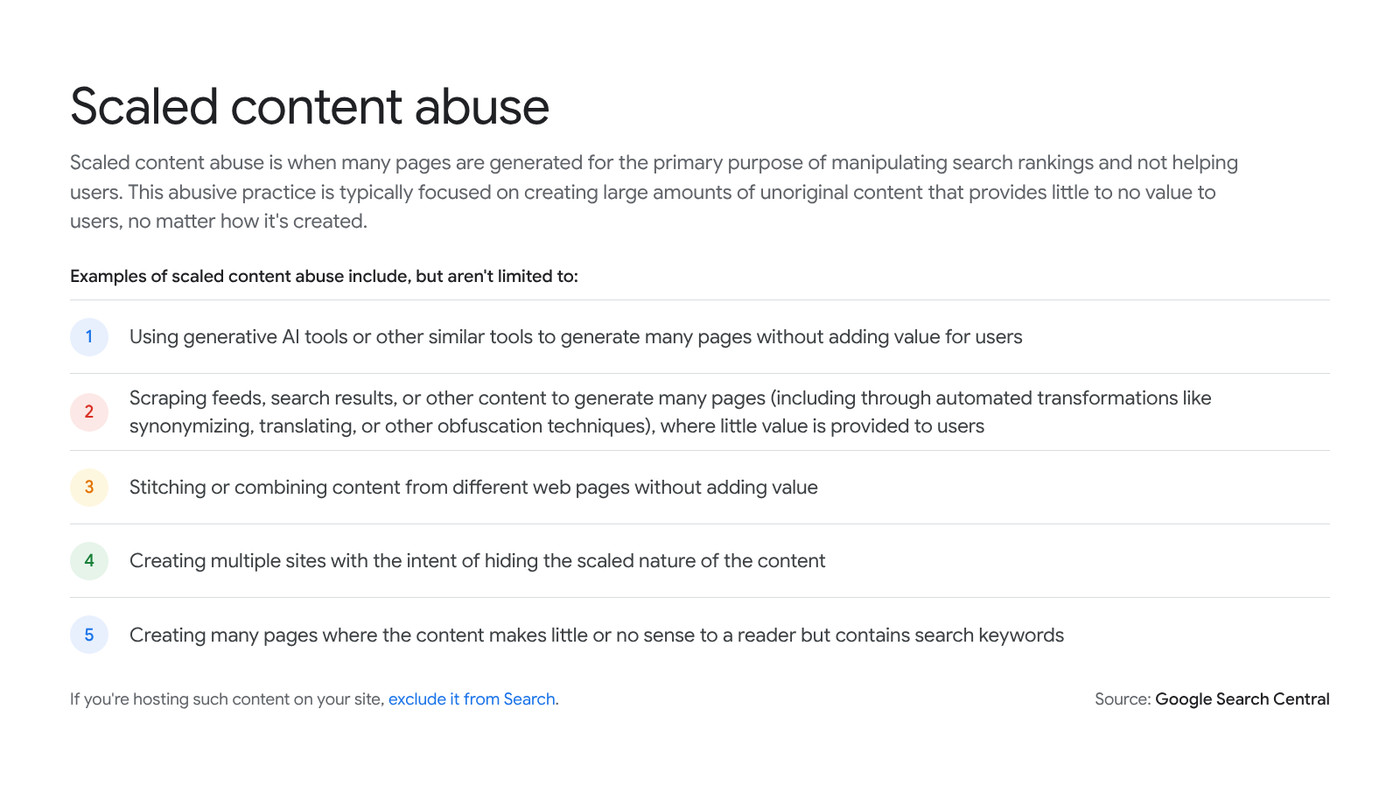
Source: Google Search Central — Spam policies
Data from researchers only reinforces this. Ahrefs studied 600,000 pages and found that 86.5% of top-ranking pages contain at least some AI content, with no link between smart AI use and ranking position.
Orbit Media’s findings are even more interesting. Their 2026 survey of 1,042 marketers found that 92.4% of them use AI for blogging, but only <14% report strong results. Marketers with a human editor beat the benchmark by nearly 2x, while replacing humans with AI entirely displayed much weaker numbers.
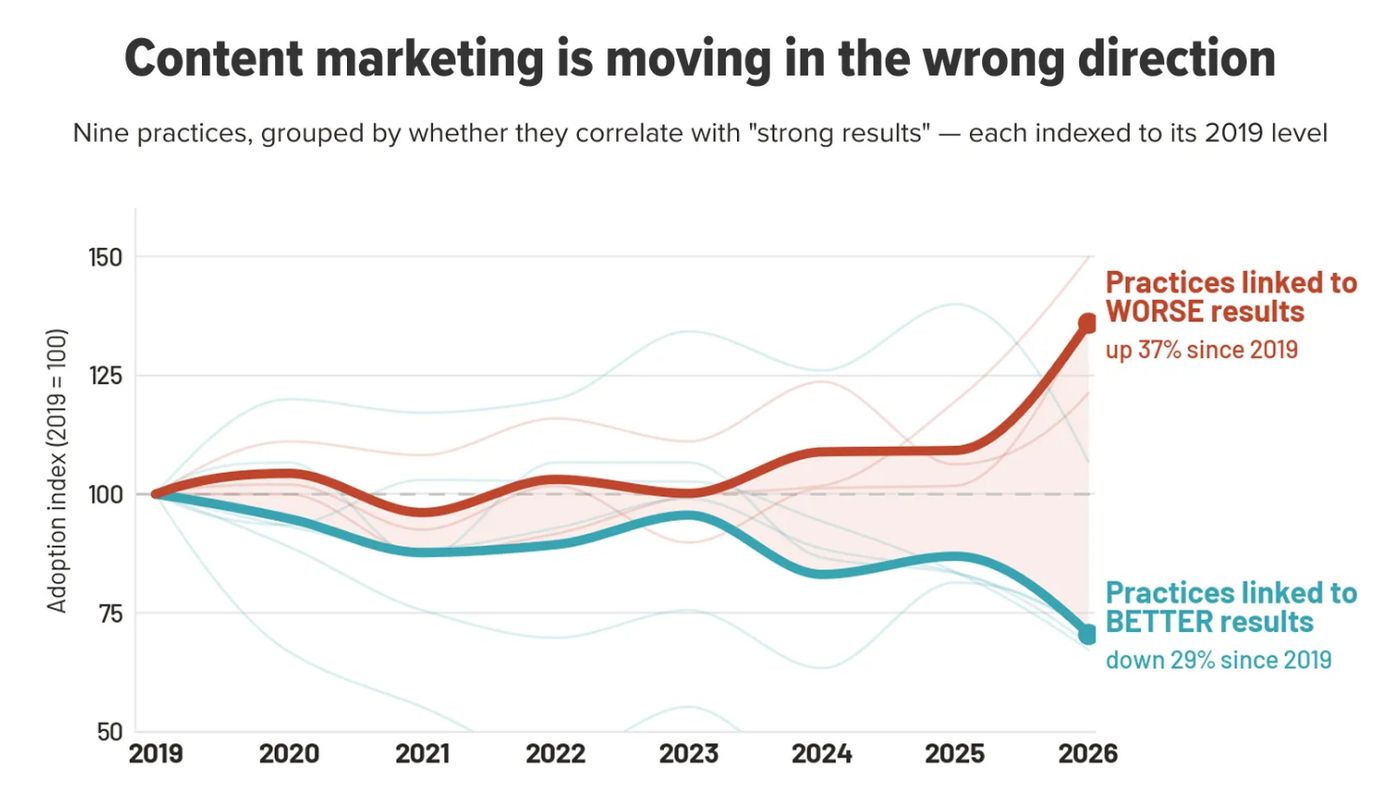
Source: Orbit Media — 2026 Blogger Survey
The takeaway: whether a draft comes from a freelancer, a platform, or an AI tool matters less than whether a human editor who knows the client checks it. For a more technical look at how AI content ranks on Google, see Does Google Penalize AI Content?
Freelancer, Agency or Content Publishing Platform?
- Freelancers suit specialist topics and clients with a strong voice or need for control. They’ll meet quality ceilings, but are hardest to scale.
- Writing agencies and marketplaces are great for steady volume across a broader client portfolio. The tradeoff is control and quality, sometimes, in exchange for faster replacements from a bench of ready copywriters.
- Automated content platforms suit SMBs and high-volume SEO blog content, where the output, not expertise, is the bottleneck. In this case, Soro can be an option: it researches keywords, writes articles, and can publish directly to the client’s CMS. Platforms that replace drafting, not the editor, give the same results as a well-run agency freelancer bench.
Many top agencies will mix all 3. They’ll hand flagship pieces to freelancers, make an in-house editor hold the line on quality, while marketplaces/agencies and content platforms handle supporting articles. SEO Content Writing Services: Complete Buyer's Guide compares the options in more detail.
Secret Ingredient to Not Losing Quality: Keeping the Feedback Loop Short
When you outsource content writing and hire a content writer, quality often drifts because feedback doesn’t reach the writer. An editor quietly fixes the same issue, and the writer never prevents it. A few habits can help prevent that and increase operational efficiency:
- Send back edits, not just approvals. Tracked-changes copy can be very helpful.
- Keep one running feedback doc per client. This can be mighty helpful if you have multiple writers working on the same client, or have a long-lasting partnership with the client, with writers leaving and coming in.
- Share client context. At least 1-2 sentences about new products or new topics to avoid. This helps outside writers stay in the loop.
- Monthly scoring. First-pass approval rate, editing time per draft, and missed deadlines. Over time, move volume towards the highest scorers.
FAQ
How Much Does it Cost to Outsource Content Writing?
Prices of content writing services run from about 4¢ to over $1 per word. Most options will settle between 6¢ per word on an AI-assisted platform and 45¢ per word for a high-level freelance blog writer. For a 1,500-word post, expect to spend roughly $90 to $675.
Is it Safe to Use Writers Who Use AI?
Google says it rewards quality regardless of how it’s produced. The risk is publishing tons of thin content that won’t add anything new. A human editor is therefore very beneficial for maintaining a clear quality standard.
Why Does the Quality of Content Writing Services Slip Over Time?
The most common causes include a poorly optimized feedback loop, lack of briefs for the writer, and hiding feedback.