
You can often be left scratching your head about why the fastest-growing or most successful competitors are where they are. You can closely match or even beat them in pricing, offer similar delivery deadlines, or possibly even ship a more polished product, yet you’re still trailing. There’s a one-word answer: marketing. Knowing how to market a small business is one of, or sometimes the single most important ingredient in the recipe for success.
The good thing is that some things are doable with no budget and no previous background. You need a plan – an order to do things in. Luckily, most things in digital business marketing run like a checklist. Our team outlines a smart way to approach things if you have an hour per week and no spare cash.
Why Free Comes Before Paid?
The U.S. Small Business Administration indicates that established small businesses dedicate 7-8% of their revenue to marketing purposes. That’s a nice benchmark, but only when the money is coming in at a reasonably steady pace. It’s not a starting point when you’re still looking for first customers.
While many entrepreneurs rely on paid ads right away, they only work if you know two things:
- Who buys from you?
- What makes them say ‘Yes’ to your proposals?
Ads are all about A/B testing and refinement, and when you don’t have much customer data (and can’t answer questions 1 & 2 consistently), you're throwing a lot of money down the drain. That’s precisely why marketing for small business should start with organic things. Not because it’s cheaper, but because it gives you insightful data on what to amplify later.
Priority One: Get Existing Customers Talking
One more thing before you begin. Work the customers you already have. In Nielsen's 2021 Trust in Advertising study, 88% of people worldwide said they trust recommendations from people they know more than they do advertising of any form. So, polish the content all you want and buy sponsored posts for weeks; people’s voices make the biggest difference.
This can work even if you’re just getting started and did plumbing jobs, sold golfing accessories, or delivered fitness plans to only a handful of people. The goal is to make those voices visible:
- Ask happy customers for a review right after the good experience – Google, Yelp, e-shop, everything works.
- Reply to every review you get, good or bad. Make a professional, specific, short, non-defensive reply. Potential customers read those.
- If you’re providing a service or delivering digital products, ask your best customers if they know anyone else who’d need what you do.
The good thing – none of this costs money. All that’s required is getting over the discomfort of asking, and often enough, that’s the difference between achieving measurable results or staying where you are.
Priority Two: Claim & Complete your Google Business Profile (GBP)
Local searches are the new crown jewel in Google’s Search. People will see your Google Business Profile first, before they dive deeper to look at your website or anything that you posted. Google says (and common sense backs that up) that profiles with complete and detailed profile info are more likely to show up as matches in relevant local searches. Hence – don’t leave the GBP incomplete.
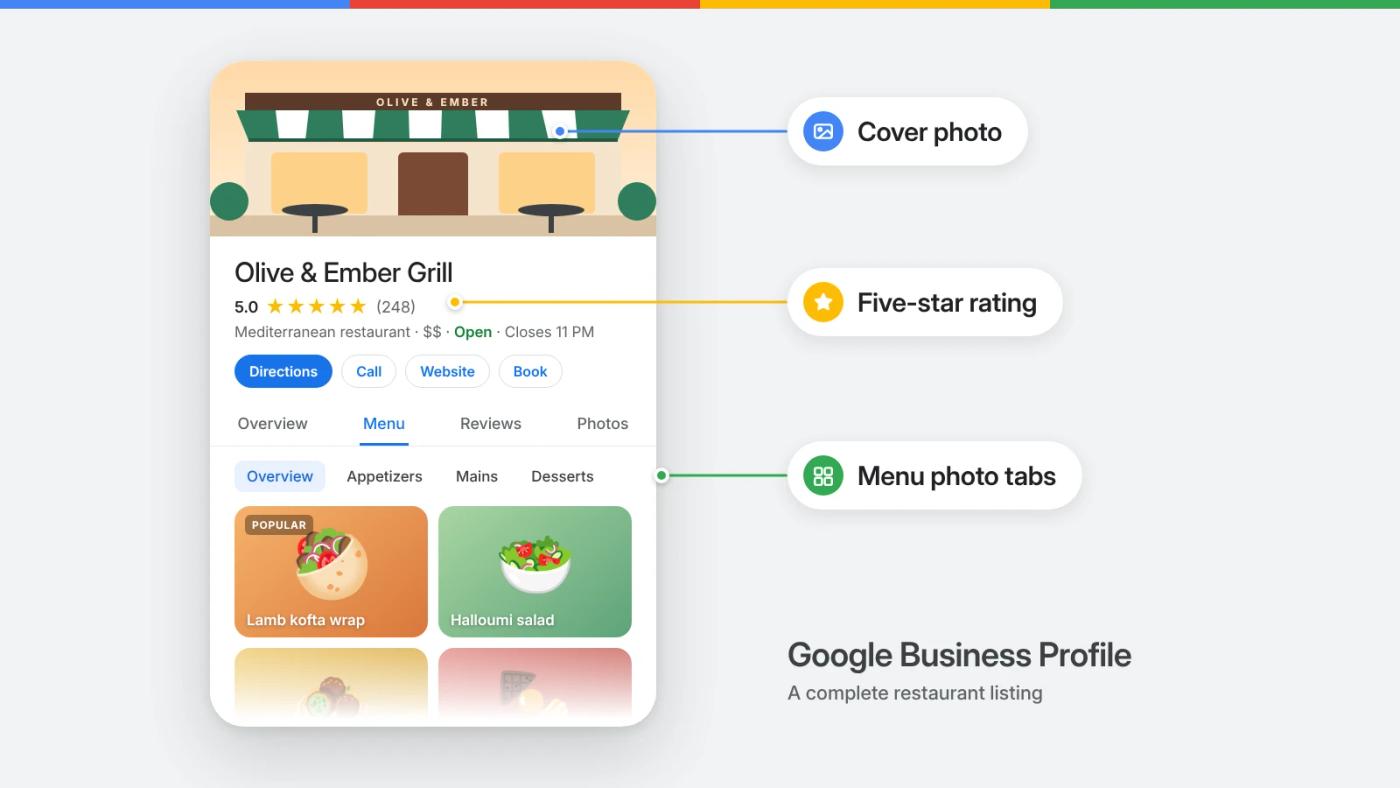
This is the level of detail you want to aim for. A real cover photo, a genuine rating, and photo categories that potential clients can scan in an instant. Here’s how to promote your business in this area:
- Fill in every field on the GBP (hours, categories, area of service, phone number, and a genuine description for the customer)
- Add real photos – storefront, team, the actual work. Don’t choose stock footage. Genuine photos read as more trustworthy, even if the compositions aren’t perfect.
- Post updates at least monthly.
This is a do-once-and-then-maintain type of job, not a permanent project. Set it up, and the GBP works for you in the background. Furthermore, if your business depends on people finding you nearby— Local SEO for Small Business: The Only Guide You Need goes deeper into the local-search side of this specifically.
Other Small Business Marketing Ideas That Don’t Cost Anything
Once those two basics are in place, you can start doing more detailed work. That’s still not buying ads, but rather showing up consistently where people look for you. We outlined 4 small business marketing ideas for that. They take time, but not money, which is exactly the trade a small enterprise is better positioned to make:
- Answer questions the customers ask you directly. Do it by making detailed FAQ sections on your website, posting blogs for these topics, and sending email newsletters. If 3 people asked you something via Live Chat/Email, probably a hundred more searched for the answer on Google or ChatGPT.
- Show up in local Facebook groups, community boards, Quora, industry-specific forums, Reddit, and anywhere else where your customers spend time. Focus on participation, not just pitching.
- Partner with complementary local businesses for cross-promotions. Be it a joint post, a shared discount, or mutual referrals. That’s a zero-cost introduction with huge potential upside.
- Build email lists from day one. Encourage visitors to sign up with discounts. It’s the one marketing channel you can fully own.
Data backs up our suggestions. HubSpot’s 2026 State of Marketing research found that small businesses are 23% more likely to see positive returns from blogging than larger ones.
Blogging is a channel that costs time and intellectual resources, as well as knowledge of your own customers, not ad spend. Plus, you can automate some things to save time (more on that later). Where larger, more generic competitors can’t specify real problems, you can do just that and fill gaps.
How to Promote Your Business Once You Have Something to Show
Since none of the things above work as a one-time push, you also need some consistent marketing efforts. HubSpot data suggests that website, blog, and SEO content ranked as the top-performing channel for B2B businesses by ROI, followed by email and paid social ads. Numbers imply that these are the smartest ways of how to promote your business.
The main calling card is that organic content keeps working after it’s been published, rather than discontinuing the moment you stop paying. So the natural question is: what to post, and how.
Consistent, Quality Posting Needs to Be Done Right
Even if a post or piece of content gets written, most first-time marketers have no way to tell whether it’s actually built to be found (e.g., SEO-optimized). Publishers need to know:
- What terms belong in the heading
- What’s the optimal length and structure
- What does the search engine want to see
- What does the customer want to see
- Many more niche details
That’s a specific, learnable skill, but not every business owner has the time or desire to get on it. One smart workaround is using Soro – a tool that automatically drafts, writes, and publishes SEO-optimised content for your blog.
Still, it’s not the only option, as you can always DIY with a few spare hours or hire a freelance writer who knows your market. Building an SEO Content Strategy From Scratch walks through the day-to-day content planning once you’re ready to move.
When to Start Paying for Ads
Ads earn the last place in this order. By the time reviews, your GBP, and some organic content are in place, you have actual data worth paying to amplify. Target the most-searched keywords, most-responded-to offers, and most engaged audiences. Skip to ads before getting this information, and you’re paying to test assumptions, which is far from efficient.
The free stage that came before pays off again here. Check your website analytics to see the actual search terms people use to find you. That’s cheap, specific proof you can use to promote your business. Once you know:
- Start with a small, capped budget - not enough to hurt in case of underperformance
- Promote the best organic performers – don’t just guess at something new
- Track one number – cost per customer, not cost per click or per impression, since that’s the number telling if the ad’s really worth it.

Source: Google Ads homepage, ads.google.com
Even if the free stage hasn’t produced any paying customers, that’s useful information too. It means the offer or the targeting, or both, need honest rethinking. SEO vs Paid Ads: An Honest Comparison for Small Business covers trade-offs in much more detail.
FAQ
Do I Need a Website Before I Start on Social Media or Google?
Not on day one, since a complete Google Business profile matters more, and sooner. However, even a simple website is worth having before you ask for reviews.
How Much Should a Small Business Actually Spend on Marketing?
SBA’s 7-8% guideline is a reasonable target for when you have steadier revenues. If you’re in a pre-revenue stage, spend time before you spend cash, and the free stage will tell you what’s worth scaling.
What’s the Most Important Marketing Task for a Brand New Business?
Setting up your Google Business Profile and asking for reviews from existing customers the moment they’ve had a good experience. It’s free and sets a solid foundation for finding ways of how to promote your business later on.
Is it a Waste of Time to Post on Social Media With No Following?
It’s less about the follower count and more about answering genuine questions in public so people and search engines can find them later. A small, but well-kept profile usually beats a large, but inconsistent one.