
If you’re about to build a Shopify store, or maybe already have one, but aren’t getting traffic from Google, the question pops up naturally: “Is Shopify even good for SEO?” Turns out – yes, since Shopify gives entrepreneurs a solid technical base that most small stores just won’t outgrow. Truth be told, the platform itself is hardly the reason why a bio supplement seller from Houston or a phone accessory creator’s website isn’t ranking well. This article will back that claim up with six months of real Chrome speed data from more than 400,000 Shopify sites, and Shopify’s own documentation.
Turns out, a lot of stores are competing on the same foundation, since Shopify runs around 7.8% of all websites with known platforms. Thus, the base matters less than what you build on top. Let’s get into it in more detail!
The Short Answer: Is Shopify Good for SEO?
Most small and mid-sized Shopify stores can get good SEO results. Shopify’s engine takes care of technical basics that owners don’t want to learn about. The e-commerce giant has a system that handles:
- Fast hosting
- Sitemaps
- Secure HTTPS pages
- Canonical tags to stop Google from getting confused by duplicates
What it can’t do is create things that actually earn rankings (e.g., useful pages and content that match what people search for).
What 6 Months of Real Data Says About Shopify's SEO Vitals
Let’s start this Shopify SEO review by talking about Google, since SEO is all about ranking well on Google.
A large part of how the search engine determines rankings is by analyzing 3 signals it calls CWV (Core Web Vitals):
- How fast the main content loads
- How quickly the page reacts when you tap something
- Whether things jump around when loading
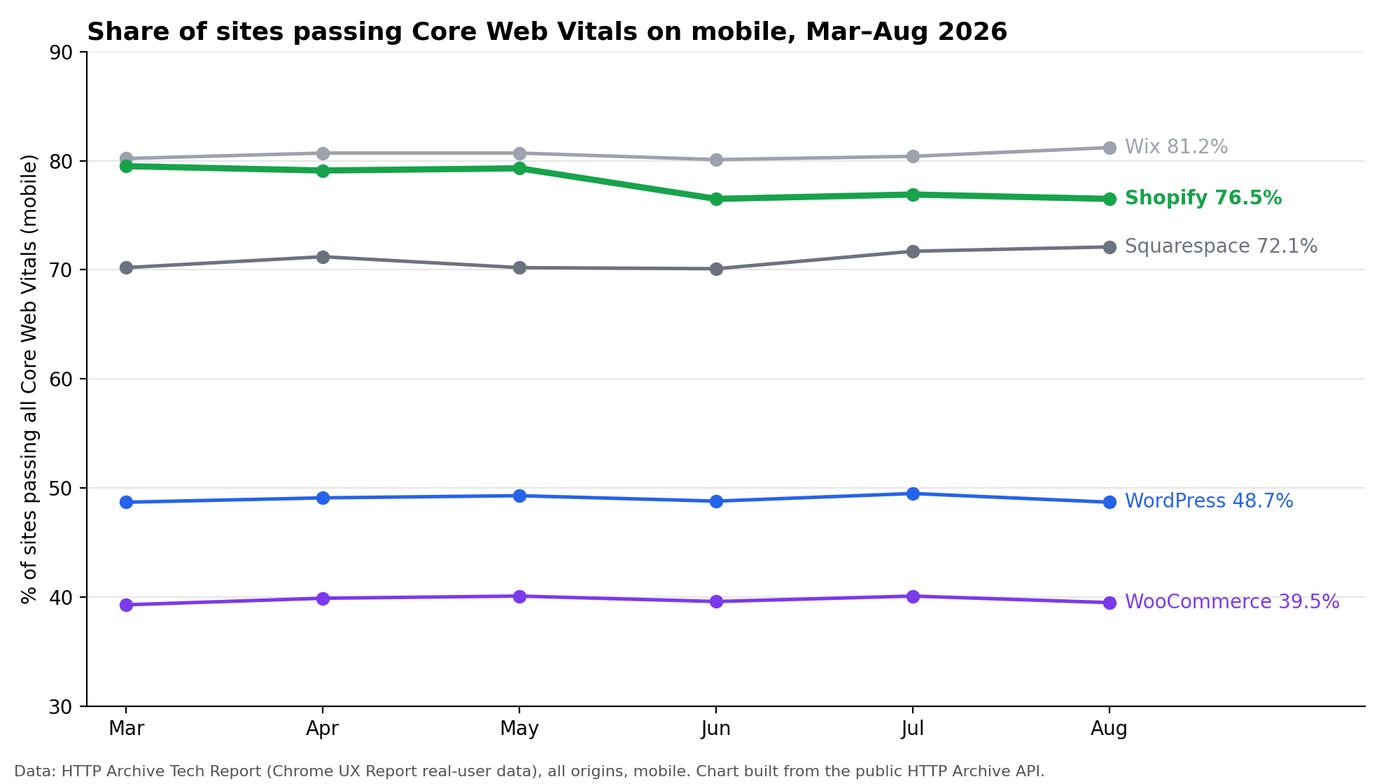
The site passes the test if most real Chrome visitors get a good experience on all 3. HTTP Archive publishes these pass rates on mobile, for every major platform each month. Here are 6 months of data from March to August 2026. According to it, Shopify is doing quite well.
Source: HTTP Archive Tech Report (chart built from its public data)
A quick glance at the chart tells us a couple of things:
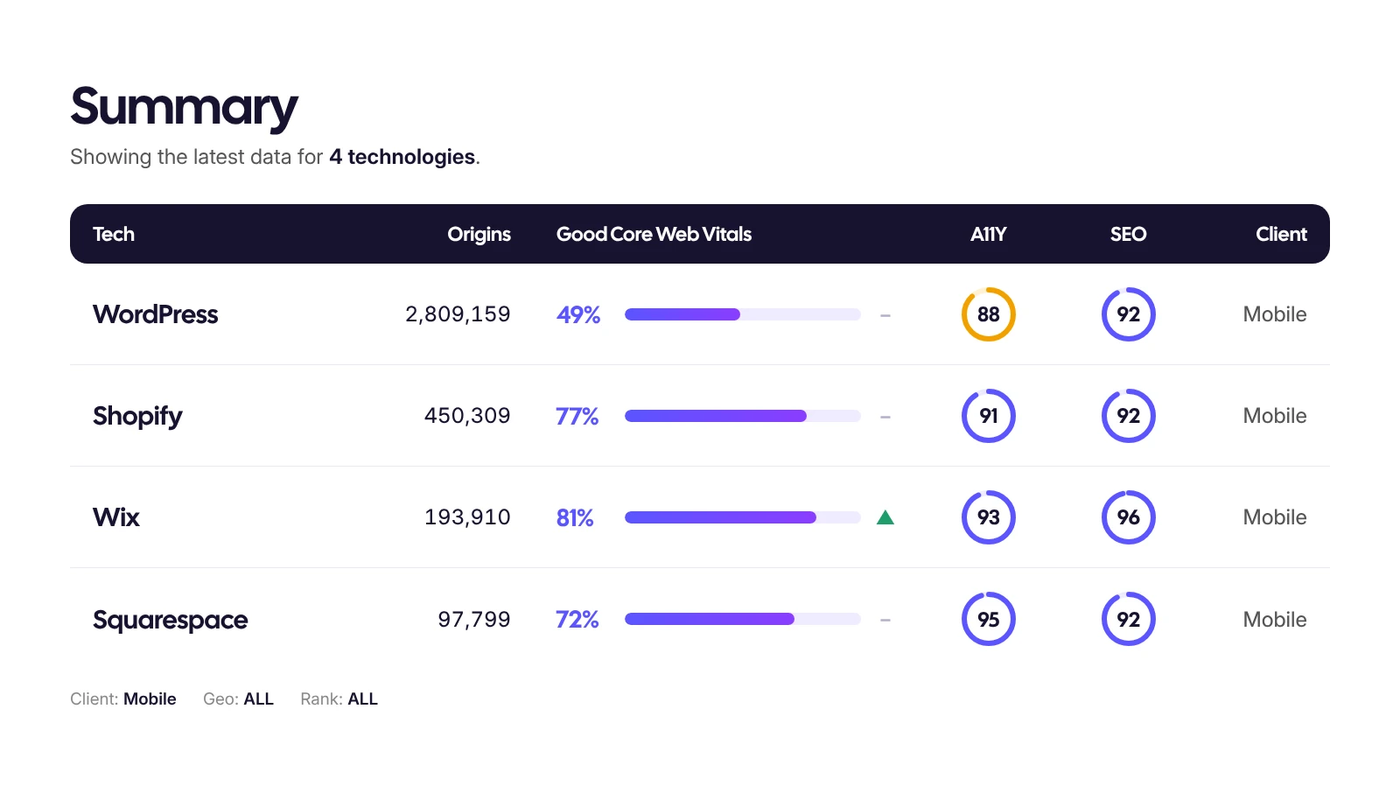
- Shopify is consistently fast. While the score was 79.5% in March, it dipped slightly to 76.5% in August across 443,647 sites with enough real traffic to measure. On desktop, it was 79.4% in August, putting it in 2nd position and displaying solid consistency.
- It’s far in front of WordPress and WooCommerce. Shopify beats out WordPress and WooCommerce sites with an average gap of roughly 28 to 37 percentage points.
- There’s just one engine ahead. Wix passed at 81.2% in the August 2026 ranking, while Shopify dipped over the 6-month period, widening the gap a bit. Shopify’s "reacts when you tap" signal slipped from 90.9% to 87.4% over the same period, and loading speeds dipped slightly, too. While it’s not a collapse of any kind, it’s still worth noting.
Source: HTTP Archive — Tech Report comparison
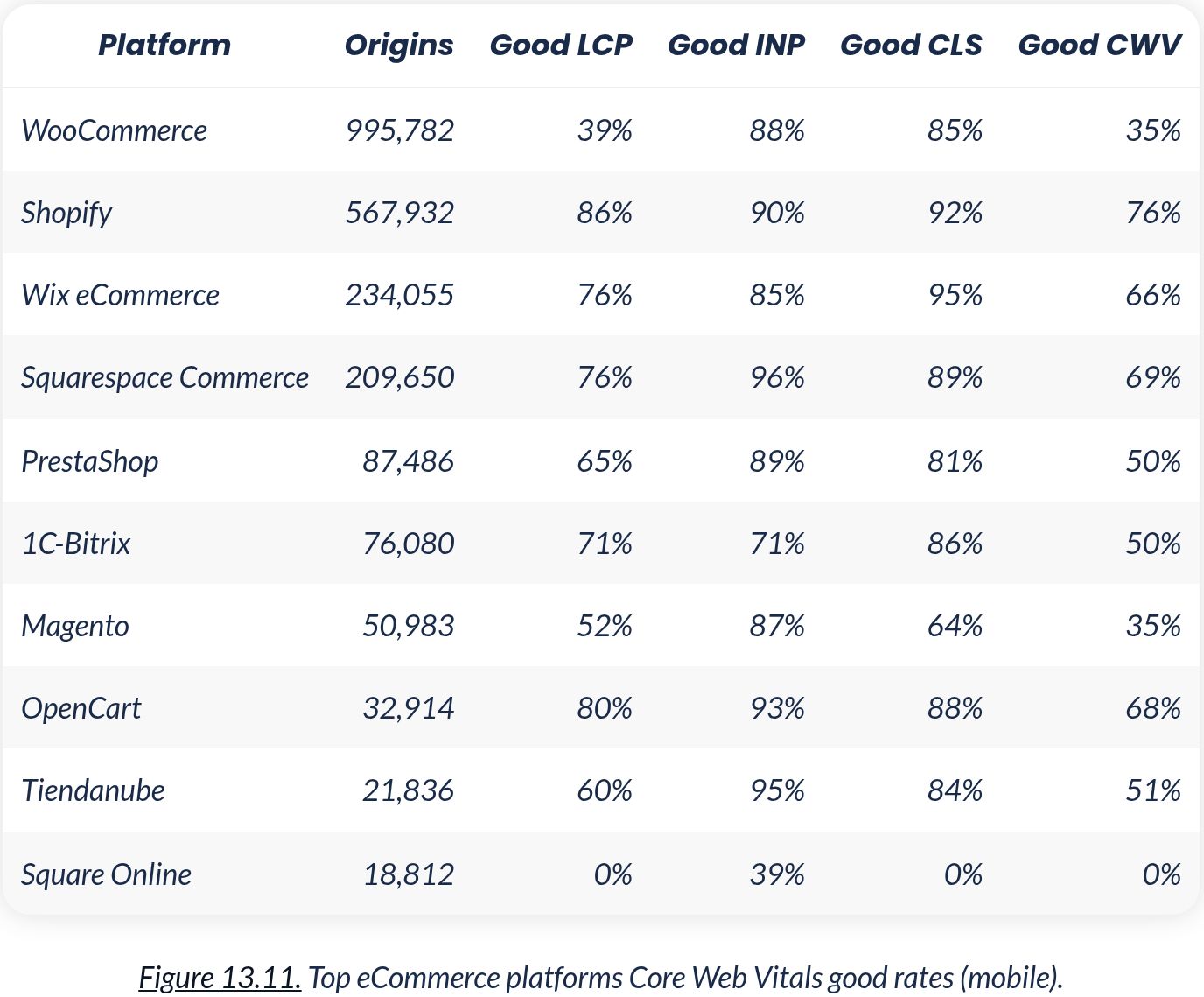
HTTP Archive also releases a yearly Web Almanac. It’s a compiled list of online stores only. In the 2025 edition, we can see more of the same story. A similar percentage (76%) of Shopify stores had good Core Web Vitals on mobile, compared to 35% on WooCommerce, one of its main rivals. Its authors put it: "WooCommerce has scale, but not automatic speed".
Source: HTTP Archive — Web Almanac 2025, Ecommerce
Word of Caution
Even with these numbers, remember that speed is just one signal among many. A fast page with thin content still won’t rank well. However, a slow store can lose shoppers before they ever see a product. All things considered, Shopify is good for SEO work because data shows it nails the basics, and you can build it further by adding content.
What Shopify Handles for You Automatically
Every new store gets these things done automatically whenever they set up the store. Since they come with the theme, you need minimal or absolutely no technical knowledge to get started. Here’s what’s handled automatically and what every Shopify SEO review must note:
- Sitemap – auto-generated sitemap.xml file that lists all products, pages, collections, and blog posts. Google uses it to find and crawl your pages.
- Protection from duplicates – Shopify adds canonical tags automatically, so Google’s robots know which version of the page is the “real” one.
- Security – SSL (noted by the padlock icon) is on by default.
- Redirects – you can point old web addresses to new locations, so you don’t lose visitors and rankings when you change a URL. Most plans allow up to 100,000 redirects.
- Built-in blog – every store has a ready-to-use “News” section that’s built for blogging.
For any beginner, that’s a very good list of things that you don’t need to set up yourself. If you’re keen on a more practical walkthrough of what matters beyond this, see SEO for E-commerce: What's Different and What Matters Most.
Where Shopify Gets in Your Way: An Honest Shopify SEO Review
Since this is an honest Shopify SEO review, we also have to mention the annoying parts. While none of these are large enough to stop a small store from ranking, they’re still real:
- Fixed URL paths. Product pages will live under /products and collections under /collections. They’re fixed Shopify paths that you can’t redirect. Blog posts also sit under /blogs/news/ unless you set up a different name for them. Since you can’t have a clean Yourshop.com/yellow-towel address, it can bother people coming over from WordPress, although rankings aren’t hurt by it.
- Robots.txt is editable, but best left alone. Robots.txt became editable in June 2021. Still, Shopify labels it as Unsupported Customization, and incorrect use could result in the loss of all traffic. Leave it alone unless you’re 100% sure of what you’re doing.
- The same product can appear at several addresses. A product shown inside a collection can load at both /collections/towels/products/yellow-towel and /products/yellow-towel. Ahrefs notes it can dilute “link equity”. Canonical tags handle it, but it’s still worth knowing about.
- Apps slowing things down. Every app has scripts that weigh down the store. The speed advantage is the platform average, so if you have 25 apps running, you are likely to fall out of the norm.
SEO on Shopify vs WordPress, Wix and Squarespace
If you want a more direct comparison on the real numbers from HTTP Archive, collected over 6 months, stacked up between Shopify and its main competitors, look at the table below.
| Platform | Passed Core Web Vitals (mobile, Aug 2026) | 6-month trend | User control |
|---|---|---|---|
| Wix | 81.2% | Steady / slightly up | Limited, but simple |
| Shopify | 76.5% | Down ~3 points since March | Moderate (fixed URL paths) |
| Squarespace | 72.1% | Slightly up | Limited |
| WordPress | 48.7% | Flat | Full control, but speed is management-dependent |
| WooCommerce | 39.5% | Flat | Full control, but speed is management-dependent |
The pattern is simple: Shopify, Wix, and Squarespace are faster by default because they handle hosting for you, and that’s important for solid SEO. On the other hand, platforms that give you full control are significantly slower. They can be just as fast, though, but someone needs to do a lot of technical work for that. If you want just to sell products and not think about servers, then Shopify is very good for SEO.
What Actually Decides Whether Your Shopify Store Ranks
Ahrefs analyzed around 14 billion web pages and found that 96.55% of them get 0 traffic from Google. The reasons Ahrefs gives have nothing to do with which platform a site runs on. Their findings conclude that it doesn’t matter whether it’s Shopify or any other engine. What matters is content, audience targeting, internal linking, and matching search intent.
After you pick Shopify, here’s the work that moves the needle:
- Product descriptions, written for shoppers – not copied from the manufacturer.
- Collection pages with short, useful intros – since collections (category/group) pages often rank for broader searches.
- Blog posts that answer questions from buyers – like “How to choose the best towels for sensitive skin?” with links to appropriate products.
Because writing takes time, the last point is where most store owners would stall. You can do it yourself by spending a few hours per week, hire a freelancer, or spend even less money and time by using Soro. It’s the only option that researches keywords and publishes SEO-optimized articles directly to a Shopify blog completely automatically.
Still, if you prefer another route, don’t hesitate to follow it. The most important Shopify SEO factor is having existing content and consistently adding more. For realistic expectations on timing, How Long Does SEO Take? breaks it down month by month.
FAQ
Is Shopify Better for SEO Compared to WordPress?
On raw speed – yes, and very much so. In August 2026, 76.5% of Shopify sites passed Google's Core Web Vitals on mobile, versus 48.7% of WordPress sites. WordPress gives more control over code, URLs, and speed management, but it requires strong technical skills, whereas Shopify doesn’t.
Do I Need an SEO App on Shopify?
Not to get started, since sitemaps, canonical tags, and SSL are built in. Apps can help with bulk edits or structured data, but add them carefully, as the e-shop can become “heavy”.
How to Get the Most from Shopify SEO as a Beginner?
First, get familiar with what the platform gives you. Then refine your website content and upload new pieces consistently to stay relevant in searches.