
A new acronym showed up in marketing circles over the past year: GEO. Generative Engine Optimization. The idea is straightforward: as more users get answers from ChatGPT, Perplexity, and Gemini, you need to optimize your content to get cited by those AI systems, not just ranked by Google.
The shift is real. Recent research shows that over a third of consumers now start their searches with AI tools instead of a search engine. But before anyone declares Google dead, the same data shows that nearly half still reach for Google first, and the vast majority of people double-check whatever AI tells them by verifying it through traditional search.
That tells you everything you need to know about where these two channels actually stand. AI is a growing discovery layer. Search engines are where trust gets confirmed. And that makes SEO more critical than ever, not less.
What SEO is (quick refresher)
Search Engine Optimization is the practice of making your content rank higher in search engine results, primarily Google, which still handles the vast majority of search queries globally.
The mechanics are straightforward. Google crawls your site, indexes your content, and ranks it based on hundreds of signals: relevance to the query, backlinks from other sites, technical performance, user engagement, and increasingly, whether your content demonstrates genuine expertise.
When you rank on page 1, users see your link, click it, and land on your site. That's traffic you own.
What GEO actually is
Generative Engine Optimization is the practice of optimizing your content to be cited or referenced by AI assistants when they answer user questions.
When someone asks ChatGPT "what's the best project management software for a 10-person team," the model synthesizes an answer from its training data and (in browsing mode or with tools like Perplexity) from live web content. GEO is about making your content the source it pulls from.
The outcome is different from a traditional Google ranking. Instead of a link click, you might get your brand name mentioned in an AI response, a citation link that users follow, or a recommendation that sends users to Google your brand directly. That last one is underappreciated. AI mentions drive brand searches, and brand searches convert at very high rates.
Why SEO matters more, not less
There's a loud narrative in marketing right now that AI search will make SEO irrelevant. The reality is the opposite.
Even among people who regularly use AI tools, search engines remain the go-to source when the stakes are high. People still prefer Google for product reviews and prices, for news and current events, for local information, and for health-related questions. These aren't niche use cases. They represent the moments where people need information they can actually trust before making a decision.
The reason is simple: people don't fully trust AI yet. The overwhelming majority still double-check AI-generated answers through traditional search. This creates what you might call a verification loop. AI suggests something. The user Googles it to confirm. If your brand shows up in the AI response but doesn't appear when the user verifies on Google, trust breaks. If you appear in both, trust compounds.
Google and other search engines are also adapting fast. Google's AI Overviews, Bing's Copilot integration, and similar features mean search engines are becoming AI-first platforms themselves. The line between "traditional search" and "AI search" is blurring rapidly. Companies that invest in SEO today are simultaneously building the foundation that makes them visible in these evolving AI-powered search experiences.
SEO isn't being replaced by GEO. It's becoming the trust layer that validates everything AI surfaces. That makes it more critical than ever.
Related reading:
- Is SEO Dead in 2026? - What's actually changed and what still works
- SEO Content Strategy - Building content that compounds over time
The real differences between GEO and SEO
They share the same foundation of good content, but the optimization levers are different.
| Factor | SEO | GEO |
|---|---|---|
| Primary signal | Backlinks + relevance + authority | Trustworthiness + clear factual statements |
| Keyword density | Matters (but less than it used to) | Largely irrelevant |
| Content structure | Headers, meta tags, internal links | Direct answers, cited claims, entity clarity |
| Outcome | Click to your site | Brand mention, citation, or recommendation |
| Measurement | Rankings, organic traffic | Brand search volume, direct traffic, citation tracking |
| Timeline | 6-12 months to see results | Ongoing as AI models update on different schedules |
The biggest practical difference is this: Google rewards content that makes users want to click. AI rewards content that is factually dense, clearly structured, and sourced from a credible entity.
Where they overlap (which is most of it)
The good news is that the things making content rank well on Google also make it more likely to be cited by AI.
Expertise signals. Google's E-E-A-T (Experience, Expertise, Authoritativeness, Trustworthiness) framework and AI citation behavior both favor content from identifiable experts on established platforms. Anonymous content on low-authority sites loses in both channels.
Clear direct answers. Google uses featured snippets to extract short answers at the top of results. AI assistants extract direct, clear answers too. If your content buries its point in four paragraphs of context, it won't get featured in either.
Comprehensive coverage. Google rewards topic authority, meaning sites that cover a subject deeply across many pieces of content. AI models trained on the web similarly weight sources that appear authoritative and comprehensive in a given domain.
Technical accessibility. If crawlers can't read your content, Google can't index it and AI can't learn from it. Fast, accessible, properly structured pages win everywhere.
Roughly 70% of good SEO practice is also good GEO practice. The remaining 30% is where you need to think differently.
Where GEO shifts the emphasis
Everything in this section matters for SEO too. Clarity, trust, and authority have always been important for Google rankings. But GEO raises the stakes on each of these because AI models are pickier about what they cite and far less forgiving of vague or generic content.
Precision over persuasion
Both Google and AI reward clear, factual content. The difference is how they process it. Google evaluates a page holistically, weighing hundreds of signals to determine ranking. AI models extract specific claims and statements to build their answers. Vague benefit-speak ("our solution drives results") gives them nothing to work with. A specific, citable claim ("companies using X tactic see an average 34% reduction in CAC after 12 months") is exactly what gets pulled into an AI response.
This matters for SEO as well. Google's featured snippets work the same way, pulling concise, factual answers directly into search results. Writing with precision improves your chances in both channels.
Entity recognition
AI models build a graph of entities (companies, people, products, concepts) and their relationships. Google does too, through its Knowledge Graph. But AI models rely on entity understanding even more heavily because they need to confidently attribute information to a source before citing it.
Your brand needs to be a clearly recognizable entity in your space. That means consistent brand name usage across the web, a Wikipedia page if you qualify, mentions on reputable publications, and a clear description of what you do that appears in multiple places phrased the same way.
If ChatGPT can't confidently describe what your company does, it won't recommend you. If Google's Knowledge Graph doesn't recognize you, you're missing out on rich results too.
Answer-first structure
AI assistants are in the business of answering questions, not guiding readers through a narrative. Content that leads with the answer and then expands is far more useful to them than content structured like a sales funnel.
Google has been moving in this same direction for years. Featured snippets, "People Also Ask" boxes, and AI Overviews all reward content that puts the answer upfront. A blog post designed to build desire before revealing the key takeaway makes a poor source for both an AI assistant and a featured snippet. Restructure popular pieces to answer first, persuade second.
Brand trust signals
AI models appear to weight brand credibility heavily. The logic is intuitive: if many people have heard of and trust a brand, it's less likely to mislead users. Trusted brands get mentioned more frequently across the web, so AI learns to surface them more often.
Google weighs brand authority through backlinks and E-E-A-T signals. AI gets at the same idea from a different angle, but the effect is similar: well-known, credible brands win in both channels. Nearly half of consumers say AI influences which brands they notice first, making AI-generated summaries an increasingly important layer of discovery. But most users still verify through Google before committing. Building brand credibility through PR, partnerships, and authoritative content feeds both your GEO and SEO performance simultaneously.
The verification loop that changes everything
This behavioral shift is the most important thing for marketers to understand right now.
Picture how a typical search works in 2026. Someone asks an AI tool for a recommendation. The AI surfaces a few brands with short explanations. The user reads the response but doesn't fully trust it, so they Google those brands to verify. They check reviews, scan the company website, and look for signals that the AI recommendation was sound.
Most people say AI gives better, clearer answers than traditional search. Yet almost all of them still double-check. People trust their own judgment more than any algorithm's recommendations, and they use Google as the tool to exercise that judgment.
This means a single brand impression now happens twice: first through an AI-generated summary, and then through search results where credibility is judged. Winning in AI gets you noticed. Winning in Google gets you trusted. You need both, but SEO is the foundation that makes the entire loop work.
Now consider the longer horizon. Children in schools and kindergartens today are already being introduced to AI tools as part of how they learn and explore information. For them, asking an AI a question will feel as natural as opening a browser does for us. In ten years, an entire generation will have grown up knowing AI as their default way of finding answers. In twenty years, even the people who spent decades relying on Google and traditional search engines will have adapted to agentic, AI-driven search experiences.
Nobody can predict exactly what that looks like. We can only forecast based on the trajectory we're seeing now. But the implication for today is clear: the brands that build genuine authority, trust, and visibility across both channels now are the ones that will still be discoverable no matter how search evolves. SEO isn't just about ranking on Google today. It's about building the kind of digital presence that survives whatever comes next.
How AI is reshaping purchase behavior
AI has moved beyond casual question-answering into real buying decisions. Nearly half of consumers have used AI to help make a purchase, relying on it to compare prices, evaluate products side by side, and get quick summaries of reviews. Among younger consumers, adoption is even higher.
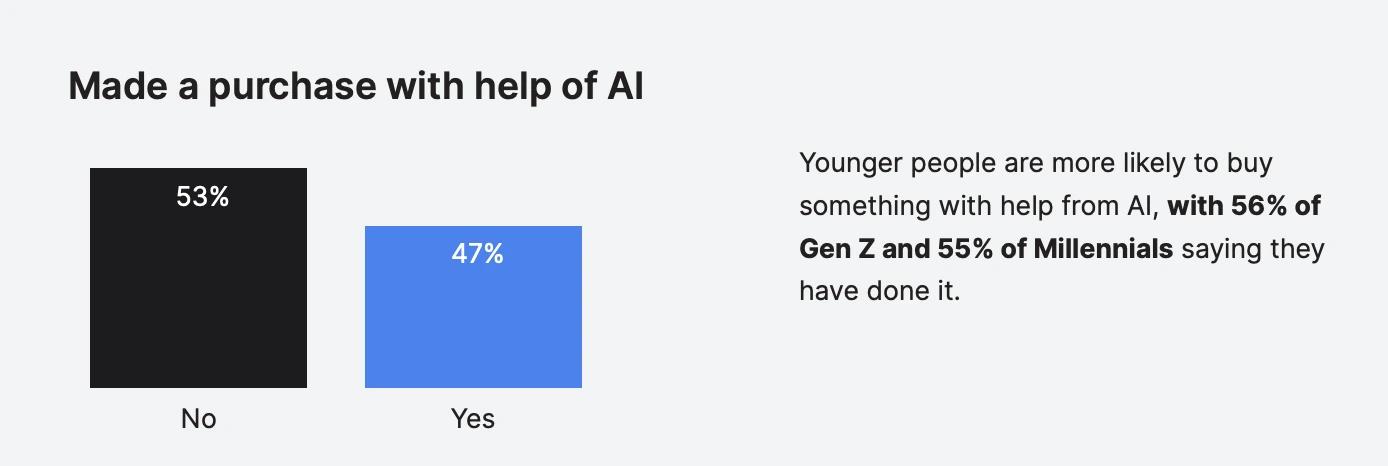
But the purchase itself still happens in familiar places. After researching with AI, the majority of buyers complete their purchase on Amazon, another major retailer, or directly on the brand's website. Only about a third follow through on a link provided by the AI tool itself.
This tells a clear story. AI is reshaping how people research. It's not yet reshaping where they buy. The brands that show up strong in both AI recommendations and traditional search results capture the full journey from initial discovery all the way through to conversion.
What to ignore
Some GEO advice floating around is either wrong or so marginal it won't move the needle.
"Use conversational language because AI is conversational." AI assistants don't favor casual content over professional content. They favor clear, accurate, well-structured content regardless of tone.
"Include FAQ sections everywhere." FAQ sections can help with Google's featured snippets, which is an SEO benefit. The GEO impact is minimal. Don't restructure your entire content strategy around this.
"Submit content to AI training datasets." You can't. Models have training cutoffs and there's no submission mechanism. The only way to influence AI output is to create content that's indexed by the web and trusted enough to cite.
"GEO completely replaces SEO." Google still drives the vast majority of web traffic and remains the most trusted digital information source after personal recommendations. Anyone telling you to abandon SEO for GEO is optimizing for their own marketing, not your results.
A practical approach that covers both
Rather than running two separate content strategies, tune your existing SEO process for both channels.
On every piece of content, lead with the direct answer to the question in the title. Make specific, citable claims backed by numbers and evidence. Structure with clear H2/H3 headers that both readers and AI can navigate easily. Include author information with real credentials. Link to credible external sources, because it signals you're engaging with the broader conversation rather than just self-promoting.
On your content calendar, cover topics as entities, not just keywords. Write about "project management" as a concept, not only "best project management software." Prioritize comparison and definition content, since these are the query types AI answers most frequently. Revisit older high-traffic pages to add specific claims and sharpen your entity positioning.
On your brand, actively pursue PR and mentions on credible publications, because this builds the trust signals both Google and AI weight heavily. Keep your About page and author bios accurate and detailed, since AI reads these to understand who you are. Be consistent with how you describe your company across every page and platform.
What the traffic actually looks like
SEO traffic is measurable in Google Search Console through impressions, clicks, and rankings by keyword. It's concrete, attributable, and directly tied to revenue.
GEO traffic is harder to track directly. The clearest signal is brand search volume. If AI is mentioning you, curious users who encounter your name in an AI response will Google your brand. An uptick in branded search volume that doesn't correspond to a paid campaign is often GEO working quietly in the background.
Direct traffic tells a similar story. Users who already know your brand from an AI mention skip the search entirely and type your URL directly.
Neither of these will replace the volume of a strong SEO ranking today. But they're additive. And as AI usage continues growing, with the majority of consumers expecting to use it even more next year, these signals will become increasingly significant alongside your organic search traffic.
The honest bottom line
GEO is real and worth paying attention to, but it doesn't make SEO obsolete. If anything, it makes SEO more valuable. As AI reshapes the discovery phase of search, the verification behavior that follows makes strong Google rankings the thing that turns AI visibility into actual trust and revenue.
Google and other search engines aren't standing still, either. They're integrating AI directly into their platforms, becoming AI-first companies in their own right. The content and authority you build through SEO is exactly what powers your visibility in these new AI-enhanced search experiences too.
The businesses best positioned for this new landscape are the same ones that were already winning at SEO for the right reasons: deep expertise, real brand authority, and content that genuinely helps people rather than just capturing keywords.
If that's you, GEO is a minor tuning exercise, not a pivot. And doubling down on SEO is the smartest move you can make.
Related reading:
- Writing Content That Ranks - The fundamentals that work across channels
- SEO for Startups - Building organic visibility with limited resources
- Content Automation - How to scale content without sacrificing quality